I performed a good friend's wedding this weekend. Given my views on relationships and my rather dour view of wedding culture in the United States, it was an interesting experience. I'm glad that I did it. I was happy to support my friend and her new partner. He gets the stamp of approval for being nerdy enough to hold a conversation about comics, Star Wars, and Star Trek. He is also quite skilled in the area of stage magic which is always a plus. The only questionable characteristic to be found is his preference for Tom Waits. In many people, this would be a fatal character flaw...the magic is impressive enough to counteract it though. And there's the whole thing about my friend loving him and stuff.
Weddings are typically nauseating affairs full of conspicuous consumption and over involvement. The delusions people harbor regarding "dream weddings" are considerable and terrifying...typically. This weekend was quite lovely, mostly relaxed, and genuinely meaningful. In short, refreshing. There was some expected drama including crying family and at least one guest, and a father of the bride MIA after spending the night out with the groom, his wedding party, and lots of Irish whiskey. Also, the skeezy DJ invading my personal space while using the line, "You have such a classic look, I feel like I know you" on me as we waited for the bridal party to get into place was fascinating and insulting all at once. I will never get aggressive, tactless passes, especially when they insult my intelligence. I sure as hell wouldn't go for one either.
The best thing about the weekend was getting to spend time with people important to me. My friend, "MJ", and her family are part of my "psychological family" (as opposed to biological). This distinction between psychological and biological family can be incredibly helpful in reconciling the notion that sometimes our biological family is not what we deserve, not something we can count on, or is simply insufficient in supporting us in the ways we need. After my family lost our home in a fire, I basically lived with MJ. A few months later when my mom was diagnosed with cancer, they were all there when I needed them. I could crash on their foldout sofa (undoubtedly the most comfortable place I have ever slept). MJ and I would have bonfires in the backyard, play badminton, listen to classic rock, and generally amuse ourselves with extreme sarcasm. Her parents, Jackie and Dez, are a second set of parents to me. They are both hippies and a ton of fun.
Dez and I get along very well having bonded over his excellent collection of sci-fi/fantasy novels and musical taste. I remember walking down to MJ's room the first time I visited her house and seeing a shelf of paperbacks over the stairs including the original Shannara series. When I spoke to Dez about them, he was shocked I had already read many of his favorite series. As I followed that up by commenting on his Boston, Fleetwood Mac, and Clapton albums after quoting Simon and Garfunkel and The Beatles, I was officially designated MJ's coolest friend ever. Then, when I used (and properly defined) "wain" in a game of Scrabble I was declared "Daughter #4", a role I will continue to gladly fulfill. Dez speaks three languages, is incredibly well read, and probably one of the only truckers with a radio preset to NPR. He has an interesting life story I might chronicle at a later date. Jackie is a sweet, kind person with a sarcastic sense of humor. She was diagnosed with multiple sclerosis before MJ and I became friends, and we've all watched as it has progressed. Despite this, she stays active and maintains her sense of humor. Dez and Jackie have been married for 42 years, a nice example of a loving and enduring relationship.
My biological family is great in many respects, especially now that we are all adults. Growing up, things were a mess emotionally, psychologically, financially, and physically. I am glad, however, that I have the support of many people in different ways including my psychological family members. Weddings seem to help me remember this.
Monday, June 9, 2014
Saturday, May 10, 2014
Musical Carl Rogers
First, observing a wisp of a woman with a cane in her 80s openly mock a set of self-absorbed college girls as they pondered deep questions about life, frat boys in boat shoes, and their venti half-caff soy lattes heavy on the foam in an elevator is definitely one of the funniest things I've ever seen. That happened yesterday, and it was excellent.
Second, thunder and lightning. I love them. More please, Weather. Seriously, so cool looking and such a turn on. If weather phenomena were cars, thunder and lightning would be a '55 Porsche Speedster. Snow and sleet, however, are a Yugo at best, or maybe a Corvette (i.e. ugly, overrated, and preferred by complete assholes with poor taste who think they know how to drive).
Third, self-care. So important. Music can be very helpful in fostering a sense of energy and restoration. It can also be a good gauge of the need for self-care. My psychological state is surprisingly easy to identify depending on the music I choose to listen to. Oldies (50s and 60s only) are for any time; it's hard to be sad when you're listening to oldies...unless you start thinking about the horribly sexist and racist nature of a good majority of the songs and the social/cultural/political climate in which the were produced. If you can embrace that, though, it's just great music.
If I am angry, upset, or generally excited about something, it typically comes down to Cheap Trick, The Who, Asia, Kansas or hair metal. Something shrieky (Mili! gasp!) or full of strong vocals with hard driving guitar gets me every time (Ah, Roger). Contemplation leads to folk rock and "classical music", although I strongly prefer the romantic era (strings and horns = automatic contentment).
When I'm in a funk or feeling buried there's a pretty specific progression. This week it started with Abby Road (Golden Slumbers on), then Boston (Don't Look Back), eventually I moved to early Rush (oh no), and it continues with The Allman Brothers. What better wallow-collect your thoughts- figure out your life-jam music is there than The Allman Bros? Musical Carl Rogers if there ever was. How does that make you feel? Like blue sky? Better than rain? Like not wasting time no more?
Friday, May 2, 2014
Emotional Rip Tide
I have a long history of nearly drowning to death starting as a young child, about 5, through age 16 when I nearly drown off the coast during a trip to Costa Rica. When I was approximately 5-years-old, I visited my uncle at his country club (don't get too excited, it was in western Wyoming...). I was curious about a vent near the bottom of the pool and I decided to investigate. I forgot/didn't realize you can't just breathe underwater and it takes time to return to the surface. My uncle jumped in a saved me. I was choking and gasping on the pool deck with random strangers looking on. My uncle asked if I was okay. I nodded, he grabbed me by my wrist and ankle and threw me back into the pool. After that I can recall at least four other instances of almost drowning. Once in a natural pool in a stream, twice at public pools, and then in Costa Rica. I'm fairly stubborn. I think many people would have given swimming up after the first few times. Ironically, I don't have a fear of swimming in the water, but I'm fairly positive I am going to die trapped in a car that careens off of a bridge into water (or so I imagine every time I have to cross the Mississippi or the Missouri). It's fairly good exposure therapy to have to drive across a bridge at least four times a day.
Something more challenging is drowning on dry land in a swirl of life. A colleague calls distress "living in pain without a voice". It has been a long time since I've been in a position to compare physical drowning with psychological drowning. The emotional experience and the corresponding physical experience is quite the same. Struggling with fear and pain while being unable to say or possibly do anything is a visceral part of being pulled under. There is also a deep sense of loneliness and helplessness which is further contrasted by a realization that death is a distinct possibility. The existentialists would encourage taking this realization into account and using it to create meaning in life.
Each time I've nearly drowned I recognized what was happening while being aware of the experience. I can tell I've been caught by an emotional rip tide, and I am being pulled further and further away from the shore. The more I fight, the worse it gets. Distress. Sometimes it is the struggle itself that causes the most harm. The trick is choosing between letting yourself slip under or allowing yourself to be carried a little further out in order to escape the current and return to shore. I think perhaps I have been treading water too long...time for action.
Friday, April 18, 2014
Top Hat Transcription: Groceries
This is literally what happens in my life when you forget the grocery list at home and ask Top Hat to transcribe it and send it by email. It also shows that no matter the situation, there is nothing that will make lettuce even remotely interesting. It's a good thing he specified bread the bakery item, not the band. I already have two of their albums...
Thursday, March 20, 2014
Adrift
She reflected on a previous conversation about the many bridges situated across from her office as she gazed at them with distracted comprehension. She had likened the bridges to life, growth, and relationships. At the time, they were a meaningful and illuminating metaphor for so many things, including hope. A total of five bridges; 1.5 intended for pedestrians, the rest assisting the daily hustle of cars and trucks across the river. The river flowed beneath them all, seemingly indifferent to the mad rush occurring above. The river knew what it was doing. It had a direction, a way of getting there, and its own timeline. And yet, it was a facade of glass with gentle ripples as it flowed along, all the while masking the tumult and fury of the undercurrent. Certainly, a more befitting metaphor for the times then the exposed, unyielding bridges. With apt irony, Neil Young brought her attention back to her desk-- the stack of papers to grade, the journal articles to read, notes to write, emails to send. The reality of the desk and its obligations evaded her generally good sense of reason and duty. Instead, she shifted her eyes and mind back to the window, the river...just drifting.
Friday, March 7, 2014
A Wunnerful Weekend: Inconceivable Chess
In an effort to regain a sense of life, humor, and fun, my good friend, Em' and I decided we needed a night of rakish behavior last Saturday. It involved a makeover for Em'; apparently the last time someone did her makeup she "looked like a hooker" with a bad spray tan (as if there is any other kind...spray tans that is). Then, we moved onto oysters, milk stout, dinner, tequila, inconceivable chess*, tequila, an oldies and hair metal sing-a-long in my living room, and tequila. Life, humor, and fun were present in abundance, as were rakishness and Luke Skywalker.
* Inconceivable Chess:
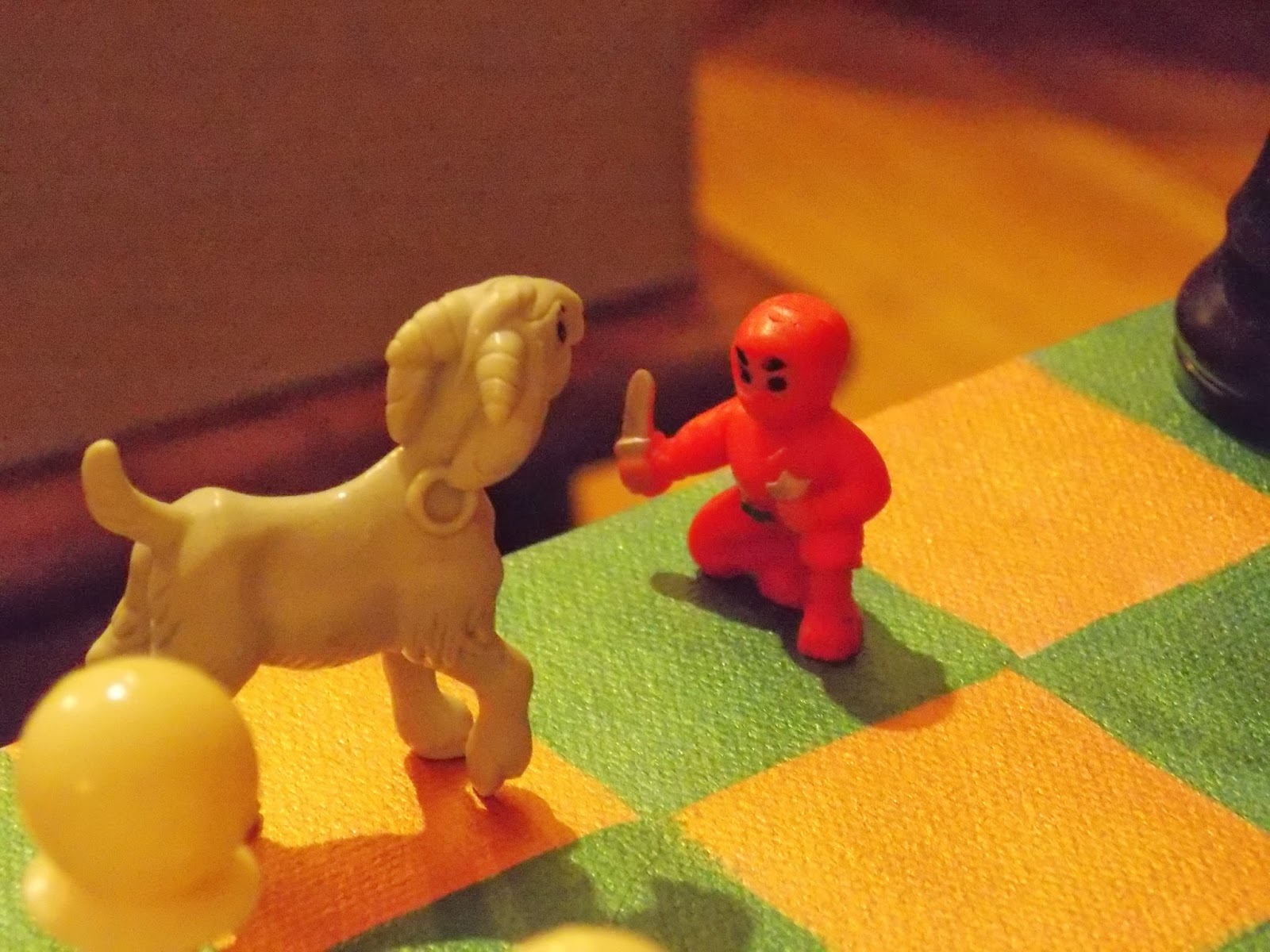
Inconceivable chess is the result of Rita's imagination, b.a.c., and desire to see people in silly hats. The rules for this game are flexible but should really be written on a flashcard used to study for a written prelim exam stating Roger's notion of the importance of counselor attitude. As you'll notice in the accompanying photos, it is important to use a durable if not unbreakable chess set in inconceivable chess. This set happens to be missing both the board and one white knight; perfect! Enter my canvass board, and the first official inconceivable chess rule:
The game proceeded like this:
Ultimately, luck on Em's part (and 12 ounces of very tasty unadulterated reposado) led to this:
I did, however, slay Em' outright in the sing-a-long/dance-a-long post chess game. I have no photographic or videographic proof to display regarding the singing and dancing, but I standby my knowledge of both oldies (50s and 60s) and hair metal. I can also do the twist while properly lip syncing.
We're gonna twist and twist and twist until we tear the house down....
* Inconceivable Chess:
Inconceivable chess is the result of Rita's imagination, b.a.c., and desire to see people in silly hats. The rules for this game are flexible but should really be written on a flashcard used to study for a written prelim exam stating Roger's notion of the importance of counselor attitude. As you'll notice in the accompanying photos, it is important to use a durable if not unbreakable chess set in inconceivable chess. This set happens to be missing both the board and one white knight; perfect! Enter my canvass board, and the first official inconceivable chess rule:
- All players must have at least two, but no more than three, "special character" chesspersons, and all players must have the same number of special character pieces. Special character pieces, however, are not fairy chess pieces and have no special moves.
The other rules of engagement:
- Play should be accompanied by classic surf rock or champagne music (note: it is ill-advised to try and watch the LWS when playing Inconceivable Chess as the LWS will a) hypnotize you b) remind you of your grandmother and c) reinforce the fact that LW was the most adorable old man ever which leads to point a) in a vicious wunnerful cycle of accordions, batons, and dancers)
- Any player who loses a piece must take one drink, unless they lost the piece to a special character which results in two drinks. Any play who loses a special character piece must take three drinks.
- Any player who is in check must wear the Tiger hat (or any other appropriately humiliating and awesome head garment).
- Any time players are mismatched in skill/knowledge (quickly established by asking each to explain basics like en passant, castling, and promoting pawns) the more advanced player must be drinking a higher-proof to level the playing field.
The game proceeded like this:
Ultimately, luck on Em's part (and 12 ounces of very tasty unadulterated reposado) led to this:
![]() |
| Checkmate... |
We're gonna twist and twist and twist until we tear the house down....
Wednesday, February 26, 2014
Know When to Fold 'Em
I'm in an unusual place of complete detachment from most everything with a sense of some crossroad approaching.
I am not good at accepting convention or authority..."authority." I have partially recognized these two personal characteristics for quite some time, but I have very recently come to a full understanding regarding just how much I struggle against them both. As a result, I've realized and accepted that doctoral level education is not necessarily an especially good fit for me. I ask too many questions, I'm too obstinate in my belief that there should be equity, justice, and accountability from students and faculty, and my drive to effect change in those areas is leaving me burnt. Also, it is difficult to be invested in yourself when you are insignificant in the eyes of an institution and the faculty.
I started a project last fall that involved asking people why they were in graduate school or why they went to graduate school. I asked specifically why they were going through/went through the journey that is graduate education given the notorious reputation it has. In general, the answers varied between, "I want to be a professor" and "I like to learn." There were some like, "A PhD equals flexibility" and "I wanted a challenge" but mostly the responses were fairly homogeneous and staid. Closer to the end of the semester, I asked a few people if their reason had changed. For some it had changed considerably, others less so. I noticed that when a change had taken place, it was typically not in a positive way. I suppose it could be argued that it was in a more realistic direction, but they often involved a sense of disillusionment and sadness. When I asked what prompted the shift, it was always some combination of institutional bureaucracy paired with a lack of support or disregard from faculty/programs. For students further along in their programs, there was a sense of draining hopelessness.
There is something truly repellent about the doctoral level of higher education. I assume that there are many factors that could make one's experience less horrid, unfortunately, the system I am currently navigating seems bereft of the large majority of them. I think I have also exhausted the modicum of resiliency in myself and my internal/external resources for bolstering it. People joke about how terrible grad school is, and there are some humorous takes on it, but in a way that makes it all the more tragic. There is absolutely no defensible reason it has to be anything less than challenging and supportive. I think the worst convention plaguing higher education is the notion that things are supposed to be miserable, and it is acceptable to maintain that perspective while doing nothing to improve it or advance. The second worst convention is that "weeding out" of students is necessary and important. If anything, what a ridiculous waste of time and money on the institution's part! It would be fascinating to see a program that is focused on supporting students from beginning to end versus establishing arbitrary and inefficient hoops for jumping through in order to pare them down. Instead of creating new rules and forcing students into precarious funding and academic situations etc., maybe helping them get what they need right away would be more efficient, effective, and economically responsible?
I am at a loss to understand how it is acceptable to maintain mediocrity based on outdated and apathetic attitudes from educators and institutions. Currently, I am hard-pressed to think of a worse defense for higher education than "it's always been done this way" or "creating a policy will fix everything." This is especially true given the mad push for research and maintaining a razor's edge on knowledge. I am sick of the unresponsive, uninvolved, screw everyone except me (or my program) attitude that pervades academics. And I'm just really sick of caring. It isn't even worth working from a place of not caring but continuing anyway.
Undoubtedly, many people have experienced similar concerns and issues. It would be absurd to think there is a uniqueness in such experience. Despite that, it's still demoralizing, yet I am not the type of person who gives up easily, or ever. I only fold to stay in the game for a better hand and higher stakes. Sometimes, I just wish I could call their bluff.
Subscribe to:
Posts (Atom)
.jpg)