Thursday, March 20, 2014
Adrift
She reflected on a previous conversation about the many bridges situated across from her office as she gazed at them with distracted comprehension. She had likened the bridges to life, growth, and relationships. At the time, they were a meaningful and illuminating metaphor for so many things, including hope. A total of five bridges; 1.5 intended for pedestrians, the rest assisting the daily hustle of cars and trucks across the river. The river flowed beneath them all, seemingly indifferent to the mad rush occurring above. The river knew what it was doing. It had a direction, a way of getting there, and its own timeline. And yet, it was a facade of glass with gentle ripples as it flowed along, all the while masking the tumult and fury of the undercurrent. Certainly, a more befitting metaphor for the times then the exposed, unyielding bridges. With apt irony, Neil Young brought her attention back to her desk-- the stack of papers to grade, the journal articles to read, notes to write, emails to send. The reality of the desk and its obligations evaded her generally good sense of reason and duty. Instead, she shifted her eyes and mind back to the window, the river...just drifting.

Friday, March 7, 2014
A Wunnerful Weekend: Inconceivable Chess
In an effort to regain a sense of life, humor, and fun, my good friend, Em' and I decided we needed a night of rakish behavior last Saturday. It involved a makeover for Em'; apparently the last time someone did her makeup she "looked like a hooker" with a bad spray tan (as if there is any other kind...spray tans that is). Then, we moved onto oysters, milk stout, dinner, tequila, inconceivable chess*, tequila, an oldies and hair metal sing-a-long in my living room, and tequila. Life, humor, and fun were present in abundance, as were rakishness and Luke Skywalker.
* Inconceivable Chess:
Inconceivable chess is the result of Rita's imagination, b.a.c., and desire to see people in silly hats. The rules for this game are flexible but should really be written on a flashcard used to study for a written prelim exam stating Roger's notion of the importance of counselor attitude. As you'll notice in the accompanying photos, it is important to use a durable if not unbreakable chess set in inconceivable chess. This set happens to be missing both the board and one white knight; perfect! Enter my canvass board, and the first official inconceivable chess rule:


The game proceeded like this:


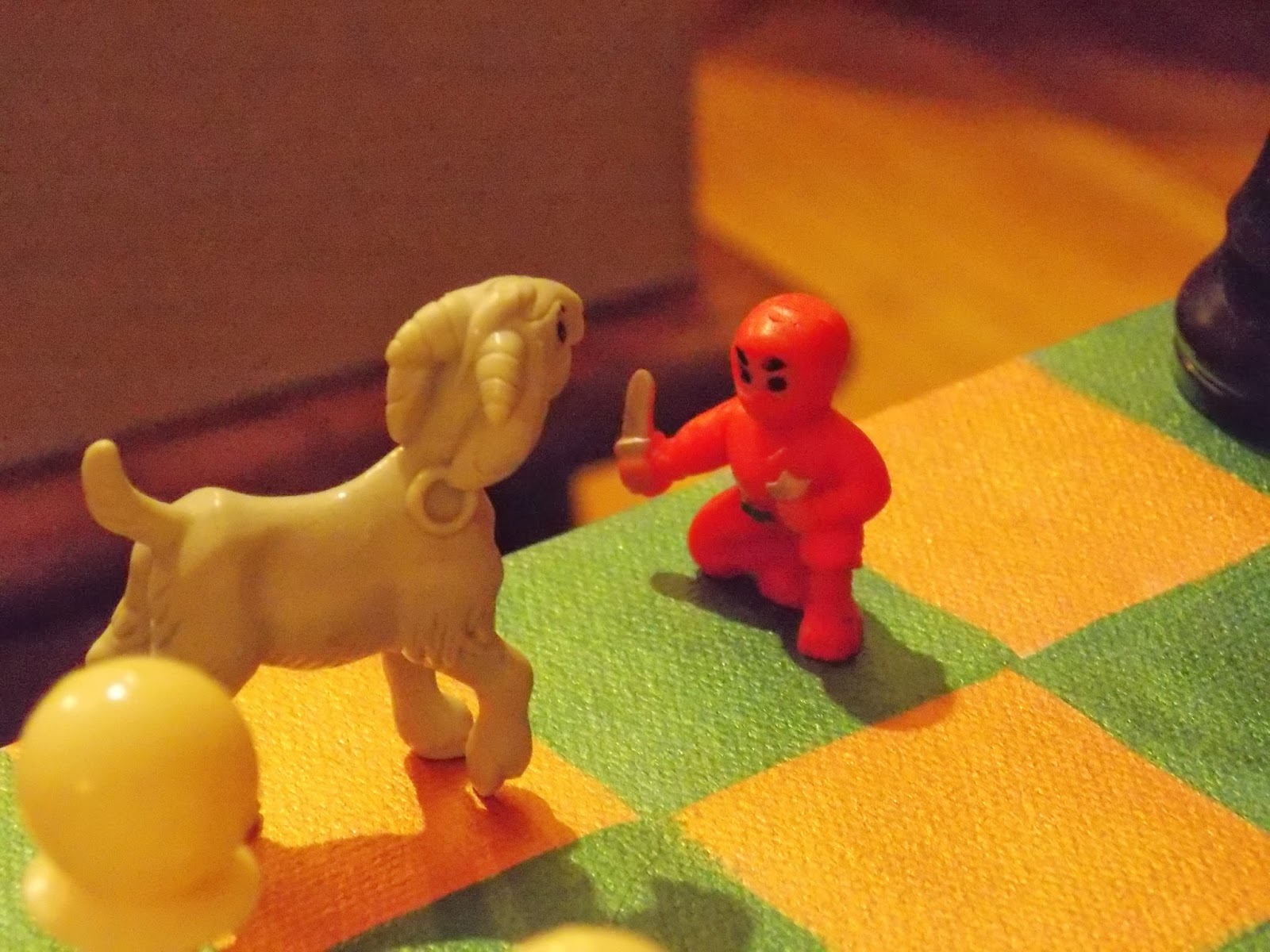
Ultimately, luck on Em's part (and 12 ounces of very tasty unadulterated reposado) led to this:
I did, however, slay Em' outright in the sing-a-long/dance-a-long post chess game. I have no photographic or videographic proof to display regarding the singing and dancing, but I standby my knowledge of both oldies (50s and 60s) and hair metal. I can also do the twist while properly lip syncing.
We're gonna twist and twist and twist until we tear the house down....
* Inconceivable Chess:
Inconceivable chess is the result of Rita's imagination, b.a.c., and desire to see people in silly hats. The rules for this game are flexible but should really be written on a flashcard used to study for a written prelim exam stating Roger's notion of the importance of counselor attitude. As you'll notice in the accompanying photos, it is important to use a durable if not unbreakable chess set in inconceivable chess. This set happens to be missing both the board and one white knight; perfect! Enter my canvass board, and the first official inconceivable chess rule:
- All players must have at least two, but no more than three, "special character" chesspersons, and all players must have the same number of special character pieces. Special character pieces, however, are not fairy chess pieces and have no special moves.
The other rules of engagement:
- Play should be accompanied by classic surf rock or champagne music (note: it is ill-advised to try and watch the LWS when playing Inconceivable Chess as the LWS will a) hypnotize you b) remind you of your grandmother and c) reinforce the fact that LW was the most adorable old man ever which leads to point a) in a vicious wunnerful cycle of accordions, batons, and dancers)
- Any player who loses a piece must take one drink, unless they lost the piece to a special character which results in two drinks. Any play who loses a special character piece must take three drinks.
- Any player who is in check must wear the Tiger hat (or any other appropriately humiliating and awesome head garment).
- Any time players are mismatched in skill/knowledge (quickly established by asking each to explain basics like en passant, castling, and promoting pawns) the more advanced player must be drinking a higher-proof to level the playing field.
The game proceeded like this:
Ultimately, luck on Em's part (and 12 ounces of very tasty unadulterated reposado) led to this:
 |
| Checkmate... |
We're gonna twist and twist and twist until we tear the house down....
Wednesday, February 26, 2014
Know When to Fold 'Em
I'm in an unusual place of complete detachment from most everything with a sense of some crossroad approaching.
I am not good at accepting convention or authority..."authority." I have partially recognized these two personal characteristics for quite some time, but I have very recently come to a full understanding regarding just how much I struggle against them both. As a result, I've realized and accepted that doctoral level education is not necessarily an especially good fit for me. I ask too many questions, I'm too obstinate in my belief that there should be equity, justice, and accountability from students and faculty, and my drive to effect change in those areas is leaving me burnt. Also, it is difficult to be invested in yourself when you are insignificant in the eyes of an institution and the faculty.
I started a project last fall that involved asking people why they were in graduate school or why they went to graduate school. I asked specifically why they were going through/went through the journey that is graduate education given the notorious reputation it has. In general, the answers varied between, "I want to be a professor" and "I like to learn." There were some like, "A PhD equals flexibility" and "I wanted a challenge" but mostly the responses were fairly homogeneous and staid. Closer to the end of the semester, I asked a few people if their reason had changed. For some it had changed considerably, others less so. I noticed that when a change had taken place, it was typically not in a positive way. I suppose it could be argued that it was in a more realistic direction, but they often involved a sense of disillusionment and sadness. When I asked what prompted the shift, it was always some combination of institutional bureaucracy paired with a lack of support or disregard from faculty/programs. For students further along in their programs, there was a sense of draining hopelessness.
There is something truly repellent about the doctoral level of higher education. I assume that there are many factors that could make one's experience less horrid, unfortunately, the system I am currently navigating seems bereft of the large majority of them. I think I have also exhausted the modicum of resiliency in myself and my internal/external resources for bolstering it. People joke about how terrible grad school is, and there are some humorous takes on it, but in a way that makes it all the more tragic. There is absolutely no defensible reason it has to be anything less than challenging and supportive. I think the worst convention plaguing higher education is the notion that things are supposed to be miserable, and it is acceptable to maintain that perspective while doing nothing to improve it or advance. The second worst convention is that "weeding out" of students is necessary and important. If anything, what a ridiculous waste of time and money on the institution's part! It would be fascinating to see a program that is focused on supporting students from beginning to end versus establishing arbitrary and inefficient hoops for jumping through in order to pare them down. Instead of creating new rules and forcing students into precarious funding and academic situations etc., maybe helping them get what they need right away would be more efficient, effective, and economically responsible?
I am at a loss to understand how it is acceptable to maintain mediocrity based on outdated and apathetic attitudes from educators and institutions. Currently, I am hard-pressed to think of a worse defense for higher education than "it's always been done this way" or "creating a policy will fix everything." This is especially true given the mad push for research and maintaining a razor's edge on knowledge. I am sick of the unresponsive, uninvolved, screw everyone except me (or my program) attitude that pervades academics. And I'm just really sick of caring. It isn't even worth working from a place of not caring but continuing anyway.
Undoubtedly, many people have experienced similar concerns and issues. It would be absurd to think there is a uniqueness in such experience. Despite that, it's still demoralizing, yet I am not the type of person who gives up easily, or ever. I only fold to stay in the game for a better hand and higher stakes. Sometimes, I just wish I could call their bluff.
Sunday, February 23, 2014
Schadenfreude: Written Prelims
In honor of my Monday and Tuesday, a comic dedicated to my cohortmates and profession:
 I always make sure to ask if they can special order one. Maybe I should check Lowe's....
Thursday, February 20, 2014
The Steak Hypothesis
My little sister made an astute observation about our father and the way he handles us when we are in distress. She noted that anytime one of is us upset about something, our father suggests we have a steak. She further posited that steak does in fact improve any situation by approximately 30-40%. I decided to test this hypothesis.
The world looks like this outside.

Inside, this is what studying for a written prelim looks like.


This is my effort at a 40% improvement in my circumstances this evening.

Ideally it would be paired with this, alas, the bottle was empty. Oh, churl, drunk all and left no friendly drop to help me after...
So, in the end I am left with this...


 ... ~55% improvement.
Wednesday, January 15, 2014
Data Use and Ethics
I've been working on this piece for a few months now trying to refine my points to create something coherent and concise. It's hard to say how successful I've been at either. I think the final impetus for finishing it was certain topics in this post about a session at the Joint Statistical Meetings, this post about data scientists vs statisticians, and a discussion on MPR about the recent data hack at Target.
As an individual just on the periphery of graduate level statistics, and someone from a profession where ethics are prominent and a part of almost every discussion, my concerns are somewhere between philosophical and questioning. As a professional consumer of data analysis and statistics, and an occasional creator, I am concerned and confused about some of the seemingly inadequate elements of both statistics and data use culture. I think some of my concerns are complicated by the transdiscipline nature of statistics and data analysis; so many people using them in so many different fields of inquiry. I also recognize that my concerns could potentially be lobbied against any number of professions and schools of thought. I would add, however, that ethical and social implications of any practice should be examined widely and openly for any profession, field of inquiry, school of thought, or general hobby. Question and lobby away as far as I'm concerned.
First, as far as "statisticians" and "data scientists" go, as an outsider, it's like Spy vs. Spy. I would contend, though, that statisticians who work as educators have a significant hand in producing budding "data scientists" anytime they are working with undergraduate students. Most of the students are not going to be statisticians, and they many only need the bare minimum in statistics to move on in their field. They learn a few cool ways to make visualizations in R, or less cool visualizations in SPSS, and they go on their way. Collecting data is unbelievably easy. Also, finding data to play around with is equally easy. Understanding the deeper concepts and responsibilities related to analysis, inference, and interpretation, that's something else. I do understand that part of educating the masses is through undergraduate education, however, higher education is a privileged experience.
I have a few questions and thoughts surrounding the professional culture of statistics and data use. I think my general questions/concerns are:
Additionally, the argument that society at large should get no further consideration because everyone benefits from changes or opportunities that result from decisions based on statistical analyses is weak. It may be true to a degree, but it lacks sufficient nuance to capture the whole situation. How can we be educated consumers if we have no foundation to think critically or to appropriately critique information provided to us? Or to critique the methods by which our personal data is collected? (Ahem, Target shoppers and Gmail users)? Is it possible to make an informed decision about something without having a basic understanding of what that something is? If our educators have gaps in their knowledge, how large is the gap they leave in the knowledge of students they teach?
In the past, the general population was guided by the intuition of individuals either naturally gifted or trained (sometimes both) to use that intuition for inquiry. Currently, as a society we are pushing the concept of omnipresent data collection, analysis, and interpretation. There continues to be some reliance on the "expert" knowledge of statisticians and trained analysts, but it seems that society is moving toward a more self-directed, self-informed, corporation supported conceptualization of data collection and use. While there are benefits to this, there are equally valid and concerning problems as well. How do we ensure data collection, use, and dissemination are done ethically and in an informed manner? Where does it start? I do not think that statisticians and data analysts are the general cause of data misuse and unethical behavior. I do, however, believe that they are uniquely positioned to mitigate the damage and harm done by the real trouble sources.
It seems likely that most formalized education in applied statistics and data work is grounded in being aware of the assumptions being made regarding the analyses and being prepared to support your position with sound theoretical or substantive reasoning. That's certainly been the bulk of my training in statistics, which by general consensus has been excellent at the graduate level. But what about the steps before and after the analysis? Ethics should be an element of all parts of an inquiry or process. Data is absolutely tied to a context, and when that context is not attended to, the possibility of erroneous conclusions and eventual harm becomes more likely.
I should state that my idea of ethics in conjunction with data use and statistics includes ethical considerations given to: whether or not data should even be collected, why and how the data are collected and stored, why and how the data are analyzed, why and how the data are presented in this way or that, why and how the "findings" and "results" are used, and perhaps the most seemingly overlooked consideration, the level of education and advocacy surrounding the appropriate and responsible use of data.
I recognize that often times statisticians are brought in after data has been collected, and they have no say in the methods used. However, with support and persistence, a culture of responsible data, especially big data, could be fostered. And who better to cultivate it then the people who have to work with the data? I cannot count the number of times I've heard comments on the quality of data people obtain and the grumbling that comes with having to get it in proper order for analysis.
The America Statistical Association has published ethical guidelines that outline a number of expectations for individuals working in the field of statistics. Some of the statements regarding ethical obligations and professional citizenship include:
Ethical guidelines are created to protect other people from you and your profession or discipline. They are also created as a form of recourse for other professionals to be gatekeepers in their profession or discipline. If those are not reason enough for ethical guidelines and training, the fact that established guidelines can provide recourse for consumers who experience unethical behavior by giving a framework for what to expect should be considered. The establishment of, and education around, ethics will not eliminate unethical behavior; and I suppose it could be argued that it does not necessarily reduce it either. However, it does allow others (professionals and consumers) to be informed and mindful.
The requirement of obligatory ethics courses and an overt culture of ethics has certainly had an impact in the field of Counseling Psychology. For example, in my current program from the first day of classes we are informed we are bound by the ethical principles of the American Psychological Association. Our syllabi include this statement, and it is highlighted in our program handbooks at both the Master's and PhD level. We are also informed that failure to comply with these guidelines is grounds for dismissal from the program (and later from the profession). Counselors in training are required to take courses in professional ethics, and then continuing education once we are licensed. Does this prevent all unethical behavior? Absolutely not. Some of it? Maybe. Perhaps the ultimate point of ethical guidelines is not prevention, but the creation of informed consumers and colleagues...
For the sake of an example in comparison to Counseling Psychology, I'll use the the resident Quantitative Methods program in my department. (This is a small sample to be sure, and it is hopefully not representative of all Quant. programs around the world.) However, going local, according to the information provided openly to prospective students and the information on their website, it appears that there are no such parallel indications or requirements for ethics. While the general program handbook makes one mention of professional ethics associated with research methodology, there are no courses on ethics, and the single comment on professional ethics is only stated for students at the PhD level. This is concerning given that MA level individuals are just as likely to have contact with the general public as PhD level data scientists, if not more. Neither the Master's handbook, nor the Doctoral handbook makes a single statement involving the word "ethics" or the ethical code to which students are bound during their course of study. The handbooks also fail to indicate where students should look for professional guidance on ethics. None of the course descriptions provided on the website include the word "ethics" or indicate how ethical reasoning and principles are applied to the work of individuals working in quantitative fields.
As an individual just on the periphery of graduate level statistics, and someone from a profession where ethics are prominent and a part of almost every discussion, my concerns are somewhere between philosophical and questioning. As a professional consumer of data analysis and statistics, and an occasional creator, I am concerned and confused about some of the seemingly inadequate elements of both statistics and data use culture. I think some of my concerns are complicated by the transdiscipline nature of statistics and data analysis; so many people using them in so many different fields of inquiry. I also recognize that my concerns could potentially be lobbied against any number of professions and schools of thought. I would add, however, that ethical and social implications of any practice should be examined widely and openly for any profession, field of inquiry, school of thought, or general hobby. Question and lobby away as far as I'm concerned.
First, as far as "statisticians" and "data scientists" go, as an outsider, it's like Spy vs. Spy. I would contend, though, that statisticians who work as educators have a significant hand in producing budding "data scientists" anytime they are working with undergraduate students. Most of the students are not going to be statisticians, and they many only need the bare minimum in statistics to move on in their field. They learn a few cool ways to make visualizations in R, or less cool visualizations in SPSS, and they go on their way. Collecting data is unbelievably easy. Also, finding data to play around with is equally easy. Understanding the deeper concepts and responsibilities related to analysis, inference, and interpretation, that's something else. I do understand that part of educating the masses is through undergraduate education, however, higher education is a privileged experience.
I have a few questions and thoughts surrounding the professional culture of statistics and data use. I think my general questions/concerns are:
- Is there a social and/or ethical obligation to provide education on a given subject to the general population by individuals trained in such subjects? For example, what level of action and advocacy for accuracy, open discussion, and education falls on learned individuals from specific disciplines regarding society at large?
- If information is created to be consumed, should the consumers be educated?
- Also, where does the education regarding the ethical use of statistics and data begin?
How and Why?
Additionally, the argument that society at large should get no further consideration because everyone benefits from changes or opportunities that result from decisions based on statistical analyses is weak. It may be true to a degree, but it lacks sufficient nuance to capture the whole situation. How can we be educated consumers if we have no foundation to think critically or to appropriately critique information provided to us? Or to critique the methods by which our personal data is collected? (Ahem, Target shoppers and Gmail users)? Is it possible to make an informed decision about something without having a basic understanding of what that something is? If our educators have gaps in their knowledge, how large is the gap they leave in the knowledge of students they teach?
In the past, the general population was guided by the intuition of individuals either naturally gifted or trained (sometimes both) to use that intuition for inquiry. Currently, as a society we are pushing the concept of omnipresent data collection, analysis, and interpretation. There continues to be some reliance on the "expert" knowledge of statisticians and trained analysts, but it seems that society is moving toward a more self-directed, self-informed, corporation supported conceptualization of data collection and use. While there are benefits to this, there are equally valid and concerning problems as well. How do we ensure data collection, use, and dissemination are done ethically and in an informed manner? Where does it start? I do not think that statisticians and data analysts are the general cause of data misuse and unethical behavior. I do, however, believe that they are uniquely positioned to mitigate the damage and harm done by the real trouble sources.
It seems likely that most formalized education in applied statistics and data work is grounded in being aware of the assumptions being made regarding the analyses and being prepared to support your position with sound theoretical or substantive reasoning. That's certainly been the bulk of my training in statistics, which by general consensus has been excellent at the graduate level. But what about the steps before and after the analysis? Ethics should be an element of all parts of an inquiry or process. Data is absolutely tied to a context, and when that context is not attended to, the possibility of erroneous conclusions and eventual harm becomes more likely.
I should state that my idea of ethics in conjunction with data use and statistics includes ethical considerations given to: whether or not data should even be collected, why and how the data are collected and stored, why and how the data are analyzed, why and how the data are presented in this way or that, why and how the "findings" and "results" are used, and perhaps the most seemingly overlooked consideration, the level of education and advocacy surrounding the appropriate and responsible use of data.
I recognize that often times statisticians are brought in after data has been collected, and they have no say in the methods used. However, with support and persistence, a culture of responsible data, especially big data, could be fostered. And who better to cultivate it then the people who have to work with the data? I cannot count the number of times I've heard comments on the quality of data people obtain and the grumbling that comes with having to get it in proper order for analysis.
Who and When?
The American Statistical Association states that students should be encouraged to follow their ethical guidelines. In practice, are they? How are statisticians and the potential data scientists they create supposed to act in accordance with these guidelines in an ethical manner if they are not aware of them? Some time ago I asked a friend, a statistics educator, how students were exposed to ethical reasoning and practice in his program. The response was that it is the student's responsibility to seek that information out. It was acknowledged that there are discussions around appropriate research design and how you treat participants in research etc. but that was essentially it. He also implied, by referencing the implementation of ethics courses at Harvard and the lack of apparent change in ethical operating in the business world, that education around ethics and ethical reasoning has little impact. I wondered how that might change if all business programs included an overt culture of ethical reasoning and action as well as ethics courses? It seems that all fields of scientific inquiry suffer from the deluded notion that their own impatience with the rate of measurable or otherwise demonstrable change equates to no change. The drive to find "significant" results at all costs has derailed many academic careers, and negatively impacted society at large (Who wants a vaccination?). It also perfectly exemplifies the need for ethics training.
- Support for improved public understanding of and respect for statistics.
- Exposure of dishonest or incompetent uses of statistics.
- "...all practitioners of statistics, whatever their training and occupation, have social obligations to perform their work in a professional, competent, and ethical manner."
- "Before participating in a study involving human beings or organizations, analyzing data from such a study, or accepting resulting manuscripts for review, consider whether appropriate research subject approvals were obtained...Consider also what assurances of privacy and confidentiality were given and abide by those assurances."
Ethical guidelines are created to protect other people from you and your profession or discipline. They are also created as a form of recourse for other professionals to be gatekeepers in their profession or discipline. If those are not reason enough for ethical guidelines and training, the fact that established guidelines can provide recourse for consumers who experience unethical behavior by giving a framework for what to expect should be considered. The establishment of, and education around, ethics will not eliminate unethical behavior; and I suppose it could be argued that it does not necessarily reduce it either. However, it does allow others (professionals and consumers) to be informed and mindful.
The requirement of obligatory ethics courses and an overt culture of ethics has certainly had an impact in the field of Counseling Psychology. For example, in my current program from the first day of classes we are informed we are bound by the ethical principles of the American Psychological Association. Our syllabi include this statement, and it is highlighted in our program handbooks at both the Master's and PhD level. We are also informed that failure to comply with these guidelines is grounds for dismissal from the program (and later from the profession). Counselors in training are required to take courses in professional ethics, and then continuing education once we are licensed. Does this prevent all unethical behavior? Absolutely not. Some of it? Maybe. Perhaps the ultimate point of ethical guidelines is not prevention, but the creation of informed consumers and colleagues...
A Snapshot?
Most individuals are born with the ability to learn language yet we go through years of formal education to learn to communicate effectively. Athletes are typically born with the ability to run, swim, jump, breath, kick, throw etc. However, they also spend years in training to enhance their performance. Statisticians and data scientists are likley naturally skilled with numbers and good internal visualizations of data; why have advanced degrees if it is something they can learn to cultivate on their own? "Critical thinking" skills are often a target skill for universities to "improve". If we can improve critical thinking performance through education, why not ethical reasoning?

This whole topic is such a bear:
Wednesday, October 30, 2013
To the Guy Who Followed Me Across Campus Tuesday Night
Hi there. You might remember me. We spoke on Tuesday night in a poorly lit, somewhat desolate and isolated spot behind the student union as I was walking to my car. I have to say, I feel somewhat badly about our interaction. But maybe I'm getting ahead of myself. In case you don't happen to remember me, let me briefly remind you of the situation, my memory of it anyway.
I was just leaving one of the classes I TA for on campus. It was about 6:30pm, and it was starting to get dark out. It takes me about 20 minutes to walk to my car from the building I TA in. I don't recall walking past you at any point in my walk, which suggests that you were either behind me, or you were in a very inconspicuous spot somewhere along the way. When you first stopped me, you were about 20 yards behind me which also indicates you had followed from some distance.
You shouted "Excuse me," twice. As I realized more fully I was walking toward an even more desolate and isolated parking ramp, instead of ignoring you completely, I stopped and turned around. As you approached, I notice four things right away. You were wearing a hoodie with the hood fully up and tied, both of your hands were in your pockets nowhere to be seen, you weren't wearing a backpack of any kind (a tad unusual for a student), and there was no one else around. I have to admit, these observations led to a very distinct sort of fear. And this is where I start to feel badly about our interaction in some ways.
I lied to you, a lot. It was not only disrespectful to you, it was beneath me, and I represented myself and my personal values poorly. You asked if I was in a specific program and commented that you thought you recognized me. I did not believe you, but I honestly replied that I was not in that program. I started to back away from you and head toward a more populated, well lit area. You followed. You then asked my name as you came around my front and blocked my way. Somewhat alarmed, I chose to give you a fake name. You asked what program I was in. Perhaps you didn't notice it, but I dropped into a moro-ashi dachi stance, a classic karate fighting stance, and placed my bag behind myself so my arms would be free. I gave you a fake program. You twitched and looked around quickly, almost as if you were watching for someone or something. Then you asked what kind of work I did in my program. Feeling very uncomfortable, but preferring non-violence or confrontation, I again lied and took a step away from you. But, hey, there you were again with the small talk! You turned quickly as two girls walked by at the far end of the square. You stepped closer and asked what I liked to do for fun. I pointedly stated I was too busy for fun, and what little time I do have I often spend with my partner (that was genuine truth). I stepped into the potential view of a group of guys hanging out in a room on the ground floor of the building next to us as you stepped closer and asked my name again. While glancing at the window into the room of guys hanging out, I gave the fake name again. When you looked up and noticed the people in the building, you visibly frowned, looked around, and took off. I waited until you turned the corner, and then I waited a few more minutes. Finally, I ran to the parking ramp, ran to my car, and drove home.
I should be up front in noting that I'm really angry that my natural response was fear. I'm mad that I have to be on guard when walking alone in the evening or at night. It really sucks that I can't just walk to my car without thinking about my personal safety. I'm angry that I was put in a position to feel intimidated, scared, and unsafe. You shouldn't just be able to stop me and ask personal questions! Or should you? Actually, that is part of the problem-- maybe you should be able to approach me without my reaction being about fear and safety. I'm upset that you were automatically a threat in my mind. After reflecting on this, I realized maybe you would be angry about this too, not only on my behalf but in regard to the fact that you are automatically a threat just because you are a guy. If you aren't angry, perhaps you will reconsider based on my reflections. I should be able to walk to my car anytime, anywhere without so much as a second thought about safety. You, however, should also be able to approach a woman, or any person actually, without being stereotyped as a threat simply because you're male. My partner, father, brother, nephews, and male friends should be able to move through life without being seen as an inherent threat to female safety as much as I should be able to live without being seen as a pair of breasts and nice smile. While my reaction is very consistent with my personal experiences and the messages I receive as a woman in US society, I'm guessing some of your behavior was the result of your experience as a man and messages you receive about what that means. This is hypocritical and a double standard, and I missed an opportunity to share a different message with you.
I realize I did not treat you respectfully. What I should have done was stated I was feeling uncomfortable and asked you politely to step away from me. By not doing this, I did not give you the opportunity to correct my assumption that you were a threat. Instead, by not saying anything, I may have given you the impression that I was interested in speaking with you. Not only that, but I disempowered myself by not being honest. Also, if you really thought you knew me, I responded quite rudely. In addition to this, I suppose it is possible you just wanted to talk to me and were unable to think of a better way to introduce yourself. Regardless, I made a potentially unfair assumption about you, and I apologize.
I am not sorry, however, for being mindful of my surroundings. I am not naive, and with the influx of crime alerts coming out on campus not attending to my surrounds would be foolhardy. If you were an actual threat and demonstrated that, I would have done whatever was necessary to protect myself. Had you attempted to engage in any sort of physical contact with me, I would likely not be expressing as much concern for the situation. No, I think my general concern about our interaction is centered on respect as you did not demonstrate you were a threat beyond some agitated, nervous behavior, a very poor location, and a poor opening line.
I appreciate our interaction as I think back on it despite the fact that I was fairly terrified the entire time we were talking. It has highlighted some of my own thinking and some potential blind spots. I think the assumption of men as inherent threats is a blind spot for a considerable number of people. Until society is ready to support interactions that are not based on fear or poor assumptions, however, I might recommend approaching people in well lit areas, hands visible, and with honestly.
Subscribe to:
Posts (Atom)